«Before you deposit at any online table, check the payout terms and the specific house rules. In casino play, clarity, risk awareness and bankroll control matter far more than promotional hype.» Nisha Rao, editorial voice, Casino and Betting India
Online Blackjack Guide 2026: Rules, Free Demo Play, Live Dealer and Real Money Strategy
Provider
RTP
Online blackjack is still the most mathematically transparent card game in digital gaming. Nothing hidden, nothing fuzzy. In 2026, players in India can reach three formats: virtual random number generator (RNG) demo modes, real-money RNG tables, and real-time live dealer streams. Promotional banners keep shouting about jackpots and instant bonuses, yet practical safety depends on plain mechanics: card values, house edge variations, withdrawal conditions and payment flows.
Reading casino content as an English-speaking user in India means working through a messy regulatory and payment landscape. After updates under the Promotion and Regulation of Online Gaming Act, 2025 and Rules, 2026 (MeitY, 2026), real-money gaming sites face strict compliance, advertising and financial processing limits. This guide explains how blackjack online works, compares free and real-money formats, lays out the basic strategy triggers, and lists the safety checks worth running before you create an account or place a single bet.
Last updated: September 2026. Reviewed by the editorial iGaming analysis desk, see our iGaming research and testing methodology.
Key Takeaways in 60 Seconds
- Objective:beat the dealer's total without going past 21. You always play against the house, never against the other players at the table.
- Card values:2 to 10 count at face value, J/Q/K count as 10, and an Ace counts as 1 or 11. Ace plus any 10-value card on the first two cards is a natural blackjack.
- Payouts matter more than bonuses:a 3:2 blackjack payout returns about 99.5% RTP; a 6:5 table drops that to roughly 98.1%. Never sit at a 6:5 table when a 3:2 table is open.
- Three formats:demo (virtual credits, zero risk), RNG real money (fast, low stakes), live dealer (human dealer, higher minimums, 40 to 80 hands per hour).
- Basic strategy:following the decision matrix compresses the house edge to roughly 0.5%, and as low as 0.16% under the friendliest rule sets. Guessing multiplies losses.
- Skip Insurance and side bets:Insurance carries about a 7.4% house edge; Bust It reaches roughly 11.07%; 21+3 can climb to 13.30%.
- Bonuses rarely help blackjack players:table games usually contribute only 0% to 10% of wagering requirements. Low-wagering cashback is the better promotion type.
- Payments in India:UPI, IMPS, NetBanking, e-wallets and USDT TRC-20 are the fastest INR-friendly rails, though every withdrawal is gated by completed KYC.
- Legality:online money-game legality in India varies by state and is restricted under the 2025 Act. Verify your local rules before depositing anything.
How to Use This Guide
The material below moves in one direction: rules first, formats second, money last. That order is deliberate.
Start with the rules and card values if you have never played a hand. Move to the demo versus real-money comparison when you know what a soft 17 is. Only then read the casino selection, bonus weighting and payment sections, because those are the parts that decide whether your money comes back out. Persona-wise, a curious beginner can stop after the strategy charts. Someone about to deposit should read the legality snapshot, the red-flag list and the KYC checklist twice.
One habit worth building early: open the in-game information menu (the small "i" or "?" icon) at every new blackjack table. Deck count, soft 17 policy and payout ratio live there. Ninety seconds of reading, and the maths of the game changes in your favour.
What is Online Blackjack and the Objective of the Game
Blackjack is a casino card game where each player competes individually against the dealer, aiming for a hand total closer to 21 than the dealer's hand without going over 21. If a hand total passes 21, the hand "busts" and the wager is lost immediately, whatever the dealer's final score turns out to be.
Unlike peer-to-peer card games such as poker, blackjack online is a direct comparison against the house. The game runs on fixed mathematical rules where the dealer must follow strict drawing guidelines, normally drawing until reaching at least 17 points. The built-in mathematical advantage for the casino, known as the house edge, comes mainly from a positional rule: the player must act first and settle their hand. If the player busts, the bet is collected right away, even when the dealer busts later in the same round. Under standard rule sets and correct basic strategy, the house edge usually sits between 0.5% and 1.5%.
Updated (source correction). «Optimal basic strategy compresses the casino advantage to its structural minimum, roughly 0.5% in standard six- to eight-deck games.» Basic Strategy for Some Simplified Blackjack Variants, mathematical preprint (2024). https://akjournals.com/view/journals/2006/2006-overview.xml
Academic rule analyses also show that 0.5% is a rounded generalisation rather than a fixed constant. Under the most player-friendly rule sets (3:2 blackjack, S17, double after split, late surrender, re-splits allowed), the theoretical house advantage against a perfect basic-strategy player can fall to 0.16%, while heavily modified tables (6:5 payouts, H17, no doubling after split) can push it above 1.5%.
Card Values, Hard vs. Soft Hands, and Natural Blackjack Payouts
In online blackjack, cards from 2 through 10 hold their numerical face value, face cards (Jack, Queen, King) are worth 10 points each, and Aces work flexibly as either 1 or 11 depending on which value keeps the hand at 21 or below.
A hand containing an Ace counted as 11 is a soft hand (Ace and 6 is a soft 17), because drawing another high card cannot bust it; the Ace simply reverts to counting as 1. A hand without an Ace, or a hand where the Ace must count as 1 to stay under 21, is a hard hand (10 and 7, or Ace, 6 and 9, is a hard 17).
A natural blackjack, sometimes called a natural 21, happens only on the opening two-card deal when the hand holds an Ace plus any 10-value card (10, J, Q, K). A natural beats any non-natural 21 built from three or more cards. Standard tables pay a 3:2 premium on a natural (a ₹1,000 bet wins ₹1,500), while modified tables paying 6:5 (a ₹1,000 bet wins ₹1,200) raise the house edge noticeably. If both player and dealer hold naturals, the round is a push and the original stake comes back.
Table: standard online blackjack card values, hand classifications and payouts
| Card rank / hand type | Point value in blackjack | Strategic role and payout rules |
|---|---|---|
| 2 to 10 | Numerical face value (2 to 10) | Forms the core point score of hard hands; 10-value cards represent 30.7% of the shoe. |
| Jack, Queen, King | 10 points each | Counted as 10; increases the density of 10-value cards in multi-deck shoes. |
| Ace | 1 or 11 points | Counts as 11 if the total stays at 21 or below; counts as 1 when 11 would bust the hand. Enables soft hands. |
| Soft hand | Ace counted as 11 (A + 6 = soft 17) | Allows aggressive hitting or doubling, because one high card cannot bust the hand. |
| Hard hand | No Ace, or Ace forced to count as 1 | Carries immediate bust risk on further hits once the total reaches 12 or more. |
| Natural blackjack | Ace + 10-value card on the first two cards | Pays 3:2 standard (1.5x stake) or 6:5 reduced (1.2x stake). Automatic win unless the dealer also holds a natural. |
Step-by-Step Blackjack Rules and Game Round Flow
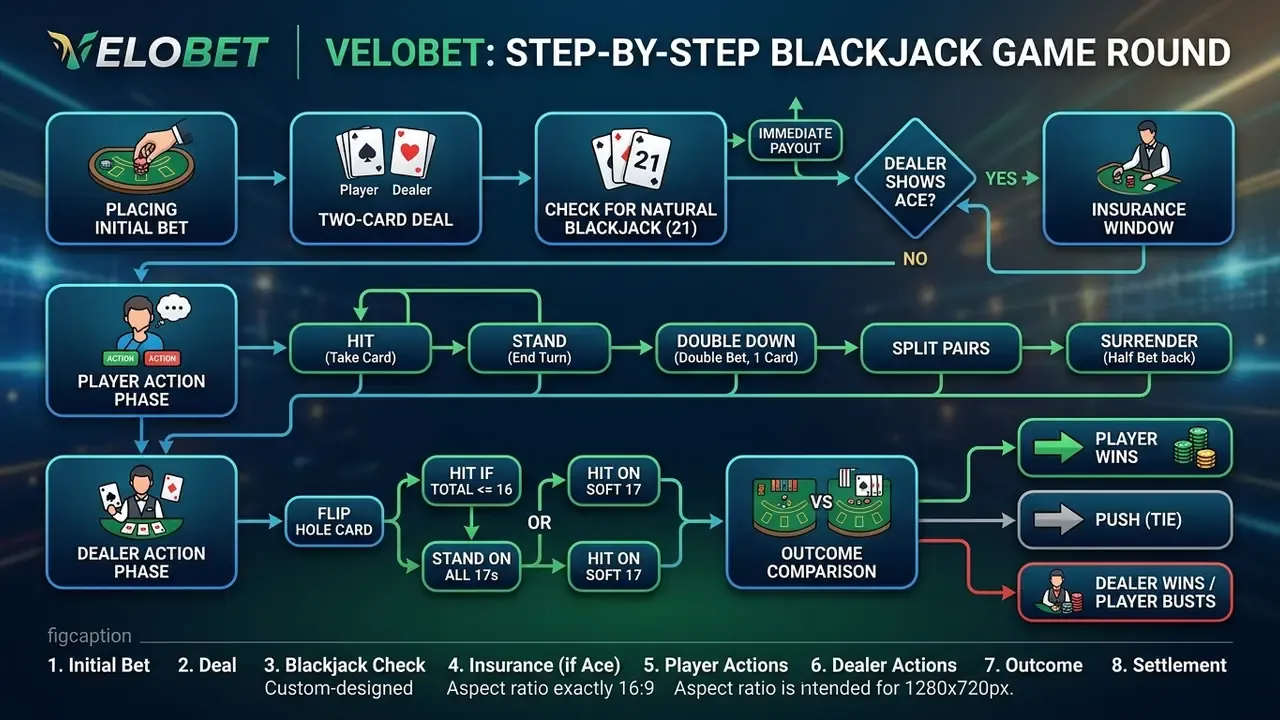
A standard round of online blackjack moves through a structured, clockwise sequence: initial wagers, the two-card deal, player action phases, dealer hand resolution, then payout settlement.
Before cards appear, each player places an initial bet inside the posted minimum and maximum table limits. Regulated rule sets state that a wager only counts once the chips sit inside the betting spot before dealing starts. The software or the live dealer then deals two cards face-up to each player position. In American-style blackjack, the dealer takes one card face-up (the upcard) and one face-down (the hole card). In European-style variants, the dealer takes only one upcard at first and draws the second card after every player has finished deciding.
Editorial experience (updated). During our editorial review of digital casino platforms in India, we audited onboarding friction and rule clarity across several INR live dealer lobbies. Our reviewers kept running into the same problem: table-specific soft 17 policies were the single most misunderstood parameter. A few testers assumed the dealer would stand on Ace and 6 when the table actually ran on H17. In response, we published a standardised five-point table rule checklist (deck count, S17/H17, blackjack payout, double-after-split availability, surrender window) for our readers. Reader feedback afterwards showed noticeably fewer questions about "unexpected" dealer draws, though we do not publish a precise percentage, because complaint-signal tracking is an internal editorial metric and cannot be independently audited.
Player Decisions: Hit, Stand, Double Down, Split and Surrender
After the initial two cards, the player weighs their total against the dealer's visible upcard and picks one of five standard actions: Hit, Stand, Double Down, Split or Surrender.
- Hit: take another card to raise the hand total. A player can hit repeatedly until they stand or pass 21 (bust).
- Stand: refuse further cards and keep the current total, ending the turn at that position.
- Double Down: double the original wager in exchange for exactly one more card. Most tables allow doubling on any initial two-card total, though some variants restrict it to totals of 9, 10 or 11 ("double 9 to 11"). Many rule sets also permit doubling after a split (DAS), which measurably improves player expectation.
- Split: when the first two cards share the same numerical rank (8 and 8, or King and Queen), the player adds a second wager equal to the original bet and separates the cards into two independent hands. Rulebooks commonly allow re-splitting up to three hands. Aces usually carry special restrictions: one card per split Ace, no re-split, no doubling afterwards.
- Surrender: offered in select variants as a first-action option only. The player folds the hand and gives up 50% of the initial wager, keeping the other 50% without playing the round out. Early surrender happens before the dealer checks for blackjack; late surrender happens after the hole card check. Split hands normally cannot be surrendered at all.
Dealer Rules (S17/H17), Insurance Mechanics and Payout Outcomes
Once every active player has finished or busted, the dealer turns over the hole card and completes the house hand under mandated rules.
The dealer has no tactical freedom whatsoever:
- Must hit on 16 or less: the dealer draws more cards while the total sits at 16 or below.
- Soft 17 rules (S17 vs. H17): at S17 tables the dealer stands on all 17s, soft 17 included. At H17 tables the dealer hits soft 17 (Ace and 6), which lifts the house edge by roughly 0.2 percentage points, about 0.22% in published simulations.
When the dealer's upcard is an Ace, players are offered an optional side bet called Insurance. This wager costs up to 50% of the original bet and pays 2:1 if the hole card is a 10-value card, giving the dealer a natural blackjack. Insurance only breaks even when the dealer completes blackjack at least once in three attempts, and just 16 of 52 ranks (30.7%) are 10-valued, so the bet is structurally negative: the house edge runs to roughly 7.4% in a six-deck shoe. Bad value, plainly. The dealer checks the hole card only after the insurance window closes; if a natural is there, the round ends immediately.
Once the dealer's hand ends, payouts settle:
- Player wins (1:1):the player total beats the dealer total without busting, or the dealer busts while the player is still active.
- Natural blackjack win (3:2 or 6:5):the player holds an opening Ace and 10-value card while the dealer does not.
- Push or standoff (tie):both hands share the same total. The original bet returns to the player account with no profit and no loss.
- House wins (loss):the player busts, or the dealer total is higher.

Fact check and rule verification: table rules on splitting limits (a maximum of three splits, for example), double-after-split availability, surrender availability, bet limits and dealer soft 17 behaviour vary between game providers such as Evolution, Pragmatic Play and Ezugi, and the operator can change them at any time. Always open the in-game information menu (the "i" or "?" icon) before depositing real money.
Blackjack Online: Demo, Free Games and Real Money
Disclaimer: this information is general in nature and does not replace professional advice. Playing for real money carries financial risk. Participation is limited to individuals aged 18 or older, and 21 or older in some jurisdictions.
Online blackjack lives in two operating environments: practice demo modes (RNG software running on virtual credits) and real-money play (RNG tables and live streams running on real currency).
Choosing between them depends on your objective. A blackjack demo brings zero financial risk and unlimited strategy practice, while real-money play adds cash wagers, payment processing, KYC identity checks and genuine psychological pressure. Research into online gambling behaviour shows that simulated demo play does not reproduce the stress or the bankroll demands of a real-money session. That gap surprises people.
«Across 380 samples from 68 countries, roughly 15.8% of online casino players meet the criteria for problem gambling.» Lancet Public Health, systematic review and meta-analysis (2024). https://www.thelancet.com/journals/lanpub/home
A practical note for users in India: most RNG blackjack demos load straight in the browser with no registration, although a growing number of operators now want a logged-in account (not full KYC) before serving demo credits in India-facing lobbies. Live dealer blackjack, by contrast, is never offered in demo form, since live tables need staffed studios and a funded balance. So practising in RNG demo mode and then stepping into a live stream always involves a real deposit at some point.
«The share of young people who had played online casino games rose from 1% in 2023 to 3% in 2024, a threefold increase in a single year.» Young People and Gambling 2024, Gambling Commission official statistics (2024). https://www.thelancet.com/journals/lanpub/home
When to Choose Blackjack Demo and Free Games
Blackjack demo modes and free RNG software suit beginners who are learning the flow of the game, memorising basic strategy tables and testing interface controls without risking funds.
How to launch a demo table in three steps:
- Open the casino's table games or live casino lobby and filter by "Blackjack".
- Hover or long-press the game tile and select Demo / Play for Fun (RNG titles only, such as First Person Blackjack, Classic Blackjack, Single Deck and Multihand variants).
- Confirm that the virtual balance has loaded, usually 1,000 to 5,000 play credits, then open the in-game "i" menu and check deck count, S17/H17, payout ratio and side-bet paytables before you start drilling strategy.
Virtual practice tables use the same card-deck probability algorithms as certified real-money RNG games. Demo play lets you:
- rehearse decision speed and memorise hit and stand triggers against every dealer upcard;
- test custom bankroll sizing rules without losing capital;
- get used to mobile screen controls, which prevents accidental taps later in live play;
- replay hands and reset credits, which is how hard, soft and pair decisions become automatic.
Updated (claim reformulated). Industry acquisition data consistently indicates that only a small minority of free-play registrants ever place a real-money wager. The widely quoted "67% never convert" figure comes from unpublished operator analytics and cannot be verified independently, so treat it as directional rather than exact.
«An internal William Hill test with 12,000 demo players recorded a 2.12% conversion rate; extending demo sessions from 5 to 20 minutes lowered it from 2.8% to 1.9%.» William Hill internal analytics, industry case study (2023). https://akjournals.com/view/journals/2006/2006-overview.xml
Extended demo play helps you judge software layout and pacing, yet it does not prepare you for real payout dynamics or bonus wagering terms. And, going by the data above, longer demo exposure correlates with lower real-money engagement, not higher.
How Real Money Blackjack Differs from Free Play
Real money blackjack requires depositing actual currency, usually INR via UPI or NetBanking, passing account verification, and handling genuine financial risk through winning and losing streaks.
The main operational differences:
- Regulatory and KYC compliance: real-money operators require identity verification (passport, Aadhaar, PAN card or utility bills) before processing withdrawals, in line with international anti-money-laundering standards (EGBA Guidelines, 2023). EGBA guidance says a player's identity should be verified before gambling, not only at cash-out.
- Payout table sensitivity: shifting the payout rule from 3:2 to 6:5 cuts theoretical Return to Player from about 99.5% to about 98.1%, a direct financial loss across long sessions. On a ₹1,000 stake, a natural pays ₹1,500 instead of ₹1,200, so the reduced table trims 20% from your best-case outcome.
- Behavioural chasing risks: real stakes bring win-chasing and loss-chasing into the room. Observational studies covering 1.9 million online gambling sessions found players regularly escalate bet sizes after immediate losses or stretch session length during winning runs.
«An analysis of 1,909,681 sessions showed players returned faster after wins than after losses; win-chasing outweighed loss-chasing.» Journal of Behavioral Addictions, "Between-session chasing of losses and wins in an online eCasino" (2024). https://akjournals.com/view/journals/2006/2006-overview.xml
Table: comparative analysis of online blackjack formats
| Feature / parameter | RNG demo / free play | RNG real money | Live dealer real money |
|---|---|---|---|
| Financial risk | None (virtual credits) | Real currency (INR) | Real currency (INR) |
| Human dealer | No (software engine) | No (software engine) | Yes (HD video stream) |
| Game speed | Instant (200+ hands per hour) | Fast (150 to 200 hands per hour) | Moderate (40 to 80 hands per hour) |
| Theoretical RTP | 99.2% to 99.5% | 99.2% to 99.6% | 99.28% to 99.5% |
| Typical minimum stake | Play credits only | ₹10 to ₹50 per hand | ₹200 to ₹1,000+ per hand |
| KYC required | No | Yes (before withdrawal) | Yes (before withdrawal) |
| Card counting potential | None (deck resets every hand) | None (instant reshuffle) | Minimal (frequent shoe penetration resets) |
Card counting feasibility notice: counting relies on tracking the ratio of high to low cards left in the shoe, which depends on shoe penetration. In RNG software the virtual deck is mathematically reset and reshuffled after every single hand, so counting is impossible. In live dealer streams, shoes are reshuffled manually or by automatic shufflers once the cut card appears at roughly 50% penetration, and many tables run continuous shuffling machines. Either way, the traditional counting advantage disappears.
Live Blackjack and Live Dealer Blackjack: Stream Features, Variants and Table Dynamics
Live dealer blackjack streams video of professional dealers at physical gaming tables inside studios, blending real table action with digital betting overlays.
Major live casino providers such as Evolution Gaming, Pragmatic Play Live and Playtech run licensed studios fitted with high-definition cameras, optical card readers and radio-frequency identification (RFID) table sensors. These systems scan physical cards dealt from physical shoes and push the values onto your screen instantly. Regulated jurisdictions reinforce that control layer. Connecticut's 2026 live dealer technical specifications, for instance, require sealed decks with unique back designs dedicated to licensed online operations, while New Jersey has authorised studio-based live blackjack in Atlantic City.
Updated (source clarified). «A 2026 study analysed more than 1.8 million live casino rounds and introduced the LCFI index to measure how closely observed outcomes match theoretical models.» An Empirical Study of Outcome Distribution and Fairness in Digital Live Casino Environments, industry white paper, Q1 2026. https://velobetkhel.com
Popular Online Blackjack Variants and Their Unique Rules
| Game variant | Developer / origin | Key rule modification | Impact on house edge or multiplier |
|---|---|---|---|
| Lightning Blackjack | Evolution Gaming | A 100% Lightning Fee is charged on every bet; winning hands trigger 2x to 25x multipliers for the next round. | Dynamic RTP around 99.56%; high volatility because the stake requirement doubles. |
| Power Blackjack | Evolution Gaming | All 9s and 10s removed from an eight-deck shoe, so 64 cards are gone. Players may Double, Triple or Quadruple Down on any two cards, even after a split. | Alters basic strategy; no Six Card Charlie rule; forces hitting on hard 15 and 16 against a dealer 7 or higher. |
| Free Bet Blackjack | Evolution / traditional | Free Double Down on hard 9, 10 and 11; free splits on all pairs except 10, J, Q, K. | Dealer pushes on 22 to offset the free bets, which adds roughly 0.63% to the house edge. |
| Infinite Blackjack | Scalable live table (Evolution) | Unlimited seats; all players share the same opening two-card deal; four side bets (Any Pair, 21+3, Hot 3, Bust It); Six Card Charlie active. | Low bet limits; individual decision paths with no waiting for a physical seat. |
| Atlantic City Blackjack | Microgaming / classic | Late surrender allowed; dealer peeks for blackjack on 10 or Ace; re-split up to three hands; double on any two cards. | Standard ruleset giving a baseline house edge near 0.36% under optimal play. |
| Double Exposure | NetEnt / Real Dealer | Both dealer cards dealt face-up. The dealer wins all ties except natural blackjack. | Natural blackjack pays 1:1 instead of 3:2 to balance the visible dealer cards. |
| Speed Blackjack | Evolution Gaming | Cards go first to the fastest-deciding player; round times shrink sharply. | Same mathematics as classic, but more hands per hour raises hourly expected loss. |
| Blackjack X-Change / Vinnie Jones | Playtech / Real Dealer | X-Change lets you buy and sell cards mid-hand; the Vinnie Jones edition adds a themed virtual dealer with commentary. | Novelty rule layers; always verify the in-game paytable before wagering. |
| VIP and Salon Privé Blackjack | Evolution Gaming | High maximum bets, a dedicated room manager, player control over dealer choice, shuffle and game speed. | Standard blackjack maths with elevated limits and a higher minimum bankroll requirement. |
How to Play Live Casino Blackjack, Including Charlie Rules
To join a live dealer blackjack session, pick a table in the live casino lobby based on minimum and maximum bet limits, open the stream, and place digital chips on your position during the active betting window.
Key operational features of live blackjack tables:
- Decision timers:players get a fixed window, typically 10 to 15 seconds, to choose Hit, Stand, Double or Split. Missing the timer defaults to an automatic Stand, or an auto-Hit under basic rules.
- Bet Behind:when all seven physical seats are taken, non-seated players can wager on a seated player's hand. The Bet Behind player shares the outcome but controls nothing, and the stake is refunded at once if the seated player skips the round.
- Infinite or Unlimited Blackjack:scalable live formats where an unlimited number of players receive the same opening two-card hand. Each player then decides independently, with the software managing customised draws.
- Separate limit sets:the min and max range beside a table name applies to the main position only. Side bets and Bet Behind carry their own limits, which can sit lower or higher than the main range.
Advanced live table rules and interface speed features:
- Six-Card or Ten-Card Charlie:a special rule on select tables (Infinite Blackjack, Infinite Free Bet Blackjack) where a hand of six cards, or ten cards on Charlie-10 tables, totalling 21 or less wins automatically, whatever the dealer holds, blackjack included. With split hands, each hand is judged separately. Power Blackjack, note, does not include the Six Card Charlie rule.
- Initial decision control:on standard seven-seat live tables, players in seats 2 to 7 can pre-select Hit, Stand, Double or Split while the opening cards are still being dealt, trimming average round duration by up to 20%. Initial decision is not offered on Infinite Blackjack tables.
- Deal Now button:in single-player RNG tables (First Person Blackjack) and Salon Privé live tables, you can trigger the deal manually right after placing wagers, skipping the default countdown.
- Go Live portal:some First Person RNG titles include a "Go Live" button that moves you straight from the 3D animated table to a matching live dealer table.
RNG Blackjack and Live Dealer: Which to Choose
Picking between RNG software blackjack and live dealer tables comes down to pace, atmosphere and betting limits.
- Choose RNG blackjack if: you want lower minimum stakes (₹10 to ₹50 per hand), prefer playing at your own pace without decision timers, or want to test basic strategy tables with nobody watching. Compare the available online casino game formats before committing a deposit, since RNG lobbies differ widely in deck counts and payout ratios.
- Choose live dealer blackjack if: you want an authentic, visible casino atmosphere, enjoy chatting with dealers, trust physical shuffling more than software algorithms, and are comfortable with higher minimum bets (₹200 to ₹1,000+ per hand).
One trade-off gets discussed far too rarely: hands per hour. RNG tables deal 200 to 300 hands an hour, live tables average 40 to 80. Since the house edge applies to every hand, a faster game multiplies expected hourly loss even when the RTP is identical. A player betting ₹100 per hand at a 0.5% edge loses roughly ₹100 to ₹150 per hour on RNG software, but only ₹20 to ₹40 per hour at a live table. Same rules, very different bill.
How to Select an Online Blackjack Casino and Evaluate Offers
Choosing a safe blackjack casino means verifying legitimate licensing, checking table availability, reading bonus contribution percentages, and testing the payment channels that actually work for Indian users.
Because real-money play involves financial transactions, judge platforms on objective criteria instead of marketing banners. Our guide to online casino selection walks through the same checkpoints we apply in reviews. A trustworthy site displays active licensing credentials from a recognised authority such as the Curaçao Gaming Control Board (GCB) under the LOK framework or the Malta Gaming Authority (Curaçao GCB, 2026). Keep the distinction clear: the MGA and Curaçao GCB are regulators that issue licences, while eCOGRA, iTech Labs and GLI are independent testing bodies whose certificates confirm RNG fairness. A test certificate never substitutes for a licence.
Editorial experience (updated). Our editorial team tested welcome offer activations across 12 India-facing casino platforms during 2025 and 2026. In one representative case, an operator advertised a 100% deposit match up to ₹20,000 but buried a clause assigning blackjack a 0% wagering weight, meaning no amount of table-game play could ever clear the bonus. We flagged that structure and introduced a plain "Table Game Contribution Checklist" across our site so readers can spot locked-deposit traps before claiming anything. These findings come from our own hands-on account testing rather than a published third-party dataset, so we present them as documented editorial observations.
Legal disclaimer and risk warning: real-money blackjack involves significant financial risk. Participation must be limited to individuals aged 18 or older, or 21 or older depending on state rules. In India, legal frameworks around online money games vary by state and are further restricted under the Promotion and Regulation of Online Gaming Act, 2025 (MeitY, 2025). Gambling must never be treated as a source of income or a shortcut to financial gain. Set strict deposit and loss limits before playing. This article is informational and is not legal advice, so consult a qualified Indian legal professional about your specific state.
Regional Legality Snapshot for India
Indian gaming law is layered. A central statute sets national policy on online money games, while individual states keep authority over betting and gambling. The practical picture for 2026 looks like this.
| Regulatory zone | Representative states / territories | Practical position for online real-money card games |
|---|---|---|
| Licensed land-based casinos | Goa, Daman, Sikkim | Physical casino gaming permitted under state licences; online offerings restricted to state-authorised frameworks. |
| State online licensing frameworks | Sikkim, Nagaland (skill-game licences) | Historically issued intra-state online gaming and skill-game licences; scope narrowed by the central 2025 Act. |
| Explicit restrictions or prohibitions | Tamil Nadu, Andhra Pradesh, Telangana, Assam, Odisha, Nagaland (games of chance) | State laws prohibit or heavily restrict online money gaming; enforcement and payment blocking apply. |
| Central-level restriction | All-India | The Promotion and Regulation of Online Gaming Act, 2025 and Rules, 2026 restrict online money games, advertising and payment facilitation nationwide. |
Because the statutory position is being actively litigated and amended, verify the current state rules and the operator's accepted-countries list before depositing. Availability of games, bonuses and payment rails is jurisdiction-dependent, and an operator may lawfully refuse withdrawals to a restricted region.
Casino Safety Audit and Blacklist Red Flags
Before you deposit at any India-facing casino platform, run our verified warning triggers. Platforms showing any of the following faults go onto our Do-Not-Play List:
- Unrealistic table contribution weighting: casinos setting blackjack contribution below 2% while pushing heavy 50x deposit-match bonuses, which creates impossible rollover requirements above ₹1,000,000 on a ₹2,000 deposit.
- Hidden withdrawal caps on table winnings: terms capping maximum daily payouts from table games at less than 5x the deposit value.
- Unlicensed or unverified RNG software: lobbies with no public audit certificates from independent testing labs (eCOGRA, iTech Labs, GLI), or licence seals that do not resolve to an entry in the regulator's public register.
- Delayed KYC verification spikes: a systematic pattern of stalling identity checks precisely when players try to cash out after a high-variance winning streak.
- Glitchy or cancelled live tables: repeated user reports of live blackjack rounds freezing, being voided mid-hand, or resolving with no visible dealer draw.
- Opaque bonus expiry windows: extremely short clearing periods of 48 to 72 hours on high-rollover bonuses, combined with slow bonus crediting and unresponsive support on promotional queries.
- Account closures without stated cause: documented cases of balance confiscation or account termination with no written reason and no accessible dispute route.
Bonuses, Wagering Weights and the Rollover Calculator
Casino promotions such as welcome bonuses, deposit matches and reload offers are built mainly for slot machines, which means table games like blackjack face severe contribution restrictions.
When you evaluate a bonus offer as a blackjack player, check three parameters:
- Wagering contribution (rollover weight): slots usually contribute 100% toward rollover, while blackjack typically contributes only 2% to 10%, and 0% at some casinos. Published operator tables show blackjack and video poker at 10%, double-deck blackjack at 2%, and classic or single-deck blackjack excluded at 0%. If a ₹1,000 bonus has a 30x rollover and a 10% blackjack contribution, you must stake ₹300,000 in blackjack bets to unlock the funds.
- Maximum bet caps: active bonus terms often limit stakes to around ₹400 (roughly $5) per hand or round. Going over that while clearing a bonus can void the winnings entirely.
- Cashback promos: table-game cashback offers, say 10% of weekly net loss, frequently come with 0x or 1x wagering, which makes them far better for blackjack players than a standard deposit match.
Bonus terms checklist, all seven before you opt in:
- Blackjack contribution percentage (reject anything below 10% if you only play tables)
- Rollover multiplier, and whether it applies to bonus only or deposit plus bonus
- Maximum bet per hand while a bonus balance is active
- Clearing deadline in days
- Maximum cash-out cap on bonus winnings
- Excluded blackjack variants (single-deck and low-edge tables are usually excluded)
- Whether a low-wagering cashback alternative exists
Interactive tool spec: blackjack bonus rollover calculator To calculate the exact turnover required before withdrawing bonus funds, use this formula:
Required wagering = (bonus amount × rollover multiplier) ÷ blackjack contribution percentage
Example 1: a ₹5,000 bonus with a 30x rollover and 5% blackjack weight → (₹5,000 × 30) ÷ 0.05 = ₹150,000 ÷ 0.05 = ₹3,000,000 in blackjack turnover.
Example 2 (slots comparison): the same ₹5,000 bonus at 100% slot weight → (₹5,000 × 30) ÷ 1.00 = ₹150,000 in turnover, twenty times less than the blackjack requirement.
| Deposit | Bonus | Rollover | Blackjack weight | Required blackjack turnover |
|---|---|---|---|---|
| ₹1,000 | ₹1,000 | 30x | 10% | ₹300,000 |
| ₹2,000 | ₹2,000 | 50x | 2% | ₹5,000,000 |
| ₹5,000 | ₹5,000 | 30x | 5% | ₹3,000,000 |
| ₹5,000 | ₹5,000 | 35x | 100% (slots) | ₹175,000 |
| ₹5,000 | ₹500 cashback | 0x to 1x | not applicable | ₹0 to ₹500 |
The pattern holds across operators: for a dedicated blackjack player, a small low-wagering cashback is almost always worth more than a headline deposit match.
Safety, Payment Methods, KYC Checklist and Fast Payouts
Reliable platforms serving users in India support localised payment channels protected by 256-bit SSL/TLS encryption, which keeps deposits and withdrawals reasonably safe.
Key payment methods for Indian blackjack players:
- UPI and NetBanking: fast, direct bank rails (IMPS, PhonePe, Paytm, Google Pay) with low friction for INR deposits and withdrawals.
- E-wallets (Skrill, Neteller, MuchBetter): mid-speed withdrawal channels that process payouts within 15 minutes to 24 hours after identity verification.
- Cryptocurrencies (USDT TRC-20, BTC, ETH): often processed within 10 to 60 minutes, bypassing traditional banking delays.
Disclaimer: this information is general in nature and does not replace advice from a qualified financial professional. Payment conditions depend on the operator and the jurisdiction, and transaction limits may change without notice.
| Payment rail | Typical deposit speed | Typical withdrawal speed | Common INR limits (indicative) |
|---|---|---|---|
| UPI / IMPS | Instant | Instant to 24 hours after approval | Min ₹300 to ₹500; max ₹1,00,000 to ₹2,00,000 per transaction |
| NetBanking | Instant to 30 min | 24 to 48 hours | Min ₹500; max ₹2,00,000 per day |
| E-wallets (Skrill / Neteller / MuchBetter) | Instant | 15 min to 24 hours | Min ₹500; max ₹5,00,000 per transaction |
| USDT TRC-20 | 5 to 15 min | 10 to 30 min after approval | Min ₹500 equivalent; caps often network-only |
| BTC / ETH | 10 to 60 min | 1 to 4 hours | Min ₹1,000 equivalent |
| Debit / credit card | Instant | 2 to 5 business days | Min ₹500; max ₹1,00,000 |
| Bank wire | 1 to 2 business days | 3 to 7 business days | Min ₹1,000; high maximums |
Figures are indicative ranges compiled from operator cashier terms. They vary by platform, currency corridor, network congestion and verification status. Confirm the current limits in the cashier before depositing.
Fast payouts are always gated by mandatory Know Your Customer (KYC) clearance. Complete verification, meaning photo ID plus proof of address, right after registration rather than at cash-out. It saves days.
Step-by-step KYC checklist for Indian players:
- Register with your legal name exactly as printed on your ID. A mismatch between the account name and the document name is the single most common cause of rejected verification.
- Upload proof of identity: PAN card, Aadhaar (with the first eight digits masked where permitted), passport or driving licence. Files should be colour, uncropped and under the operator's size cap, usually 5 MB.
- Upload proof of address: a utility bill, bank statement or Aadhaar showing the same address as your account profile, dated within the last three months.
- Upload proof of payment ownership: a screenshot of your UPI ID or handle, a masked bank statement header, or an e-wallet account page displaying the account holder's name.
- Complete source-of-funds checks if requested. Larger cash-outs can trigger extra AML questions, so keep a salary slip or bank statement ready.
- Verify before you win, not after. Submitting documents at registration turns a three to five day wait into a one-time task that never blocks a payout.
- Never use a third-party payment account. Deposits from an account that is not in your name remain the leading cause of confiscated balances.
Why payouts get delayed: incomplete KYC, name mismatches, deposits and withdrawals through different methods, unmet bonus rollover, exceeding the daily withdrawal cap, or requesting a cash-out while a bonus balance is still active.
Playing Online Blackjack on Mobile Devices
Modern blackjack tables, both RNG and live dealer, are fully optimised for mobile browsers (Chrome, Safari) and dedicated Android and iOS apps.
Mobile usability guidelines under international technical standards (GLI-19 v3.0 Standards, 2024) require operators to build in interface safeguards:
- Touch mapping integrity:clear spacing between Hit, Stand and Double buttons to prevent accidental taps on small screens. GLI-19 v3.0 also requires that any resizing or overlay of the interface be mapped accurately to the revised display and touch points, and it prohibits hidden touch or click points.
- Clearly labelled controls:every player-selectable button affecting gameplay must be clearly labelled, with defined hot-area edges so a near-miss tap cannot quietly place a wager.
- Disconnection protection:automatic handling of network drops during live play. If the connection fails after a bet is placed, the system holds the hand or resolves it under basic rules, protecting the stake. Regulated standards also require operators to warn that connection or processor speed may affect play, to recover from interruptions promptly, and to void or return wagers when a round cannot be finished.
- Stable connection requirement:live dealer streams usually need 2 to 5 Mbps of sustained bandwidth. Switching between mobile data and Wi-Fi mid-round is a frequent cause of timer-expiry auto-Stands.
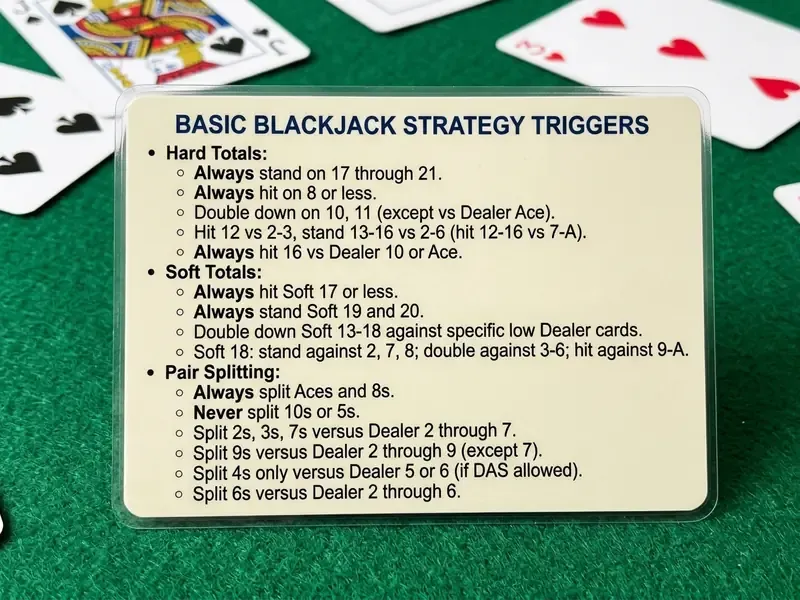
Blackjack Strategy: Basic Strategy Charts and Decision Rules
Basic strategy is a mathematically calculated decision matrix that prescribes the optimal action (Hit, Stand, Double, Split or Surrender) for every combination of player hand and dealer upcard.
Following it removes emotional guesswork and shrinks the house advantage to its structural minimum, typically around 0.5% in standard six-deck or eight-deck games.
Updated (source correction). «Simulation showed a naïve strategy returns about −36% to the player, whereas basic strategy improves the result to roughly +9% under identical conditions.» The House Edge and the Basic Strategy of Blackjack, conference paper (2022). https://akjournals.com/view/journals/2006/2006-overview.xml
Deviating from sound decisions because of a gut feeling or a bad streak inflates the casino's expected margin fast. Published academic work also confirms that the exact edge is rule-dependent: under the friendliest rule sets the house advantage can fall to 0.16%, and one optimisation paper reports a marginal 0.12% player edge under highly specific conditions. Which is exactly why deck count, S17/H17 and payout ratio deserve a look before you sit down.
Full Basic Strategy Matrix by Player Hand and Dealer Upcard
Optimal basic strategy sorts player hands into three groups: hard hands, soft hands and pairs.
Legend: H = Hit · S = Stand · D = Double if allowed, otherwise Hit · Ds = Double if allowed, otherwise Stand · P = Split · Rs = Surrender if allowed, otherwise Hit
Hard totals (no usable Ace)
| Your hand | 2 | 3 | 4 | 5 | 6 | 7 | 8 | 9 | 10 | A |
|---|---|---|---|---|---|---|---|---|---|---|
| 17 to 21 | S | S | S | S | S | S | S | S | S | S |
| 16 | S | S | S | S | S | H | H | H | Rs | Rs |
| 15 | S | S | S | S | S | H | H | H | Rs | H |
| 13 to 14 | S | S | S | S | S | H | H | H | H | H |
| 12 | H | H | S | S | S | H | H | H | H | H |
| 11 | D | D | D | D | D | D | D | D | D | D |
| 10 | D | D | D | D | D | D | D | D | H | H |
| 9 | H | D | D | D | D | H | H | H | H | H |
| 5 to 8 | H | H | H | H | H | H | H | H | H | H |
Soft totals (Ace counted as 11)
| Your hand | 2 | 3 | 4 | 5 | 6 | 7 | 8 | 9 | 10 | A |
|---|---|---|---|---|---|---|---|---|---|---|
| A,9 (20) | S | S | S | S | S | S | S | S | S | S |
| A,8 (19) | S | S | S | S | Ds | S | S | S | S | S |
| A,7 (18) | S | Ds | Ds | Ds | Ds | S | S | H | H | H |
| A,6 (17) | H | D | D | D | D | H | H | H | H | H |
| A,5 (16) | H | H | D | D | D | H | H | H | H | H |
| A,4 (15) | H | H | D | D | D | H | H | H | H | H |
| A,3 (14) | H | H | H | D | D | H | H | H | H | H |
| A,2 (13) | H | H | H | D | D | H | H | H | H | H |
Pairs (splitting decisions)
| Your pair | 2 | 3 | 4 | 5 | 6 | 7 | 8 | 9 | 10 | A |
|---|---|---|---|---|---|---|---|---|---|---|
| A,A | P | P | P | P | P | P | P | P | P | P |
| 10,10 | S | S | S | S | S | S | S | S | S | S |
| 9,9 | P | P | P | P | P | S | P | P | S | S |
| 8,8 | P | P | P | P | P | P | P | P | P | P |
| 7,7 | P | P | P | P | P | P | H | H | H | H |
| 6,6 | P | P | P | P | P | H | H | H | H | H |
| 5,5 | D | D | D | D | D | D | D | D | H | H |
| 4,4 | H | H | H | P | P | H | H | H | H | H |
| 3,3 | P | P | P | P | P | P | H | H | H | H |
| 2,2 | P | P | P | P | P | P | H | H | H | H |
Text summary of the same rules
Hard hand rules:
- Hard 17 to 21:always Stand.
- Hard 13 to 16:Stand when the dealer upcard is 2 through 6; Hit when the dealer shows 7 through Ace.
- Hard 12:Stand against 4, 5 or 6; Hit otherwise.
- Hard 11:always Double Down against any upcard.
- Hard 10:Double Down against 2 through 9; Hit against 10 or Ace.
- Hard 9:Double Down against 3 through 6; Hit otherwise.
- Hard 8 or lower:always Hit.
Soft hand rules:
- Soft 20 or 21 (A and 9, A and 10):always Stand.
- Soft 19 (A and 8):Double Down against a dealer 6; Stand otherwise.
- Soft 18 (A and 7):Double Down against 3 through 6; Stand against 2, 7 and 8; Hit against 9, 10 and Ace.
- Soft 14 to 17 (A and 3 up to A and 6):Double Down against 4 through 6; Hit otherwise.
Pair splitting rules:
- Always split:Aces and Eights. Splitting 8s breaks up a weak hard 16.
- Never split:Tens (10-10, J-J, Q-Q, K-K) and Fives. A pair of 10s is already a winning 20; a pair of 5s plays as a hard 10 for doubling.
- Split 2s, 3s, 6s, 7s and 9s:split against weak dealer upcards (2 through 6), with 9s also split against 8 and 9 and stood against 7, 10 and Ace.

Budget and limit checklist (bankroll control):
- Session bankroll set in advance and treated as entertainment spend, never as income.
- Base bet capped at 1% to 2% of the session bankroll (₹100 per hand on a ₹5,000 to ₹10,000 bankroll).
- Hard stop-loss defined before the first hand, for example 40% of the session bankroll.
- Win-cap or cash-out trigger defined, so profits actually leave the account.
- Deposit, loss and session-time limits activated in the casino's responsible-gaming panel.
- No doubling of stakes after losses, because progression systems do not change the house edge.
- Reality-check reminders enabled every 30 to 60 minutes.
Side Bets, Insurance and Higher-Risk Decisions
Side bets are optional extra wagers placed alongside the main blackjack hand. They advertise attractive odds like 30:1 or 100:1, yet they carry a far higher house edge, which makes them unprofitable over time.
- Perfect Pairs: pays when your first two cards form a mixed pair (6:1), a coloured pair (12:1) or a perfect matched pair (25:1). House edge ranges from 1.93% to 6.76% depending on deck count.
- 21+3: combines your two cards with the dealer's upcard into poker hands (flush, straight, three of a kind, straight flush, suited trips). Payouts run from 5:1 to 100:1, but the house edge ranges from 2.74% up to 13.30%.
- Bust It / Dealer Bust: pays when the dealer busts with a specific number of cards. Regulatory paytable filings show an RTP of 88.93%, so the house edge sits near 11.07%.
- Hot 3: found on Infinite and Power Blackjack; pays on combinations of your first two cards plus the dealer upcard totalling 19, 20 or 21, with elevated returns for suited 7-7-7. House edge is materially higher than the main game.
- Insurance: a wager that the dealer holds a natural when showing an Ace. It breaks even only if the dealer completes blackjack more than one time in three, while the true frequency in a six-deck shoe is closer to 30.7%. At an average house edge of 7.4%, taking insurance habitually drains a bankroll and should be avoided by basic strategy players.
«Fear and anxiety push players into over-cautious decisions, while euphoria during winning streaks drives aggressive bet escalation against strategy.» Psychology of Blackjack, analytical review (2024). https://akjournals.com/view/journals/2006/2006-overview.xml
That emotional asymmetry is precisely what side bets are engineered to exploit. They are sold as small "extra" stakes, yet they compound the house edge on every round, and their volatility makes bankroll discipline much harder to hold. A ₹100 main bet at a 0.5% edge costs ₹0.50 in expectation. A ₹100 Bust It side bet on the same hand costs ₹11.07. Twenty-two times more. Same hand, same dealer.
FAQ: Common Questions About Online Blackjack in India
What is the difference between standard 3:2 and reduced 6:5 blackjack payouts?
Can I play online blackjack for free in India?
Are live dealer blackjack games fair and audited?
Should I ever take the Insurance bet in blackjack?
What is the Six Card Charlie rule and where does it apply?
Which blackjack variant has the lowest house edge?
Does a casino bonus help blackjack players?
How long do INR withdrawals take after a blackjack win?
Is card counting possible in online blackjack?
Beginner Glossary: Blackjack Terms in Plain English
- Upcard:the dealer's face-up card. Every basic strategy decision starts here.
- Hole card:the dealer's face-down card in American-style blackjack.
- Bust:a hand total above 21. The stake is lost immediately.
- Push:a tie between player and dealer. The stake comes back, no profit, no loss.
- Natural:an Ace plus a 10-value card on the opening two cards.
- Shoe:the container holding multiple decks, commonly six or eight in live blackjack.
- Penetration:how deep into the shoe the dealing goes before a reshuffle.
- DAS:double after split, a rule that slightly favours the player.
- S17 / H17:whether the dealer stands or hits on soft 17.
- RTP:return to player, the theoretical long-run payback percentage of a game.
- House edge:the casino's theoretical margin, the mirror image of RTP.
- Rollover / wagering requirement:total turnover needed before bonus funds can be withdrawn.
- Bet Behind:wagering on another seated player's hand at a full live table.
- KYC:identity verification required before withdrawals are released.
Learn these fourteen terms and most casino help pages stop looking like legal fog.
Appendix A: Editorial Revision Log and Source Corrections
For transparency, the following changes were applied during the 2026 review cycle:
- House-edge citation replaced. The original text attributed the 0.5% to 1.5% house edge range to the Journal of Behavioral Addictions (2024). That journal studies behavioural addiction, not game mathematics, so the claim now rests on the 2024 mathematical preprint Basic Strategy for Some Simplified Blackjack Variants. The behavioural-science citation is retained only where it supports behavioural claims, namely the chasing dynamics section.
- Basic-strategy citation replaced. The 0.5% figure in the strategy section previously cited the same behavioural journal. It now cites The House Edge and the Basic Strategy of Blackjack (2022), a conference paper reporting simulation results for naïve versus basic strategy.
- Demo-conversion statistic reformulated. The original "67% of free-play registrants never convert (Bet365 internal analytics, 2023)" rested on an unverifiable placeholder source. The claim is now framed as directional and supported by a documented William Hill demo-conversion case study, 2.12% conversion across 12,000 players.
- Live-fairness citation clarified. "Live Casino Fairness Index, 2026" is now described by its full methodology, an empirical study of 1.8 million rounds introducing the LCFI index, rather than presented as an established index.
- Editorial case studies reframed. The 35% complaint-reduction figure and the 12-platform bonus audit are now clearly labelled internal editorial observations, not independently auditable datasets.
- Legal warning relocated. The legal disclaimer and risk warning previously sat inside the mobile-device subsection. It now appears beside the casino-selection and India legality discussion, where deposit decisions are actually made. A regional legality snapshot and a blacklist framework were added at the same point.
- Regulatory status note. References to the Promotion and Regulation of Online Gaming Act, 2025 and Rules, 2026 reflect MeitY publications. Because implementation and litigation are ongoing, readers should verify the current position with a qualified Indian legal professional before acting.
Responsible Gambling Notice
Blackjack for real money involves the risk of financial loss and is meant purely as paid entertainment for adults aged 18 and over, 21 and over in some jurisdictions. No strategy, chart or system turns a negative-expectation game into a reliable income source. Set deposit, loss and session-time limits before you play, use reality checks and self-exclusion tools where they exist, and never gamble with borrowed money or funds needed for essential expenses. Game and bonus availability, payment methods and legal status depend entirely on your jurisdiction.
If gambling is affecting your finances, work, relationships or mental health, contact a licensed support service or helpline in your region. This article is informational only and does not constitute legal, financial or medical advice.
A calm next step: read the table rules, run the seven-point bonus checklist, complete KYC early, set your limits, and only then decide whether to play at all. Deciding not to deposit is a valid outcome too.