Online Roulette: Rules, Demo Mode, and Real Money Play

Reviewed and updated: January 2026 | Editorial review: Casino and Betting India analysis desk | Reading time: about 22 minutes

"Before you deposit a single rupee at an online casino, test the game mechanics in demo mode and verify the platform's payout terms. Roulette is a game of pure mathematical chance: no strategy alters the house edge, and a larger bonus usually comes with strict wagering limits on table games." Nisha Rao, Editorial Lead, Casino and Betting India

ℹ️ Editorial note on experience and methodology This guide was compiled by our iGaming research desk, which regularly tests table-game lobbies, payment rails and bonus terms on platforms serving Indian users. Payout ratios, house-edge figures and rule mechanics were cross-checked against provider rule sheets and published regulatory standards (UK Gambling Commission RTS, Nevada Gaming Control Board table-game rules, Singapore Gambling Regulatory Authority game rules). Nisha Rao is our editorial voice for India-facing casino guides, an editorial persona rather than a public commentator, and every claim published under that byline is desk-verified against the sources listed. See our broader iGaming research and testing methodology for how platforms are scored.

Provider

Evolution Gaming

RTP

97.30%

Volatility

Low

Min bet

$0.01

Max bet

$75,000

Max win

35:1
Online Roulette Rules, Demo Mode, and

Quick Summary for Roulette Players

  1. The wheel decides everything. European and French wheels have 37 pockets (single zero) and a 2.70% house edge; American wheels have 38 pockets (0 and 00) and a 5.26% house edge. Always choose single zero when both are on offer.
  2. French roulette is mathematically the best version. La Partage or En Prison cut the edge on even-money bets to 1.35% (98.65% RTP).
  3. No betting system beats the maths. Martingale, Fibonacci, Labouchère and Andrucci change the shape of your wins and losses, never the expected value. Every spin is an independent random event.
  4. Demo mode cannot pay you. Free tables use virtual credits with zero cash value, and live dealer tables are almost never available in demo. Real money play activates table limits, KYC and payment rules.
  5. Bonuses treat roulette harshly. Table-game contribution rates typically fall to 5-25%, so a ₹1,000 roulette bet may count as just ₹100 toward wagering. Check max-bet caps before you deposit.
  6. India-specific reality check. Roulette is legally classified as a game of pure chance, which places it outside the "game of skill" exemption in most Indian state statutes. Verify your state's law, KYC document requirements (PAN or Aadhaar) and UPI or NetBanking availability before funding an account.
Quick Summary for Roulette Players. 1

Roulette Glossary: Nine Terms You Will Meet at Every Table

If you are new to the game, this short vocabulary will make the rest of the guide much faster to read. Nothing here requires maths beyond simple fractions.

  • Pocket:one numbered slot on the roulette wheel. Thirty-seven on a European wheel, thirty-eight on an American one.
  • House edge:the built-in casino margin, expressed as the share of each stake you lose on average over a long run.
  • RTP (Return to Player):the mirror image of the house edge. A 2.70% edge equals 97.30% RTP.
  • Inside bet:a wager placed inside the number grid, covering 1 to 6 pockets, with higher payouts and lower hit frequency.
  • Outside bet:a wager on a broad category such as Red, Odd or a dozen, covering 12 or 18 pockets at lower odds.
  • Racetrack:the oval betting panel that follows the physical wheel order instead of the felt grid. Used for call bets.
  • RNG:the certified random number generator that decides outcomes in software-based roulette online.
  • Live dealer:a real human host spinning a physical wheel in a studio, streamed to your screen in real time.
  • Wagering contribution:the percentage of a roulette bet that counts toward clearing a bonus. Often far below 100%.
Roulette Glossary Nine Terms You Will

Keep that last one in mind. It quietly decides whether a bonus is worth claiming at all.

Roulette Rules: How the Table Game Works

A round of roulette follows a structured sequence: players place chips on specified table sectors during the betting window, the wheel spins in one direction while a small ball is spun in the opposite direction, and outcomes are determined when the ball comes to rest in a numbered pocket.

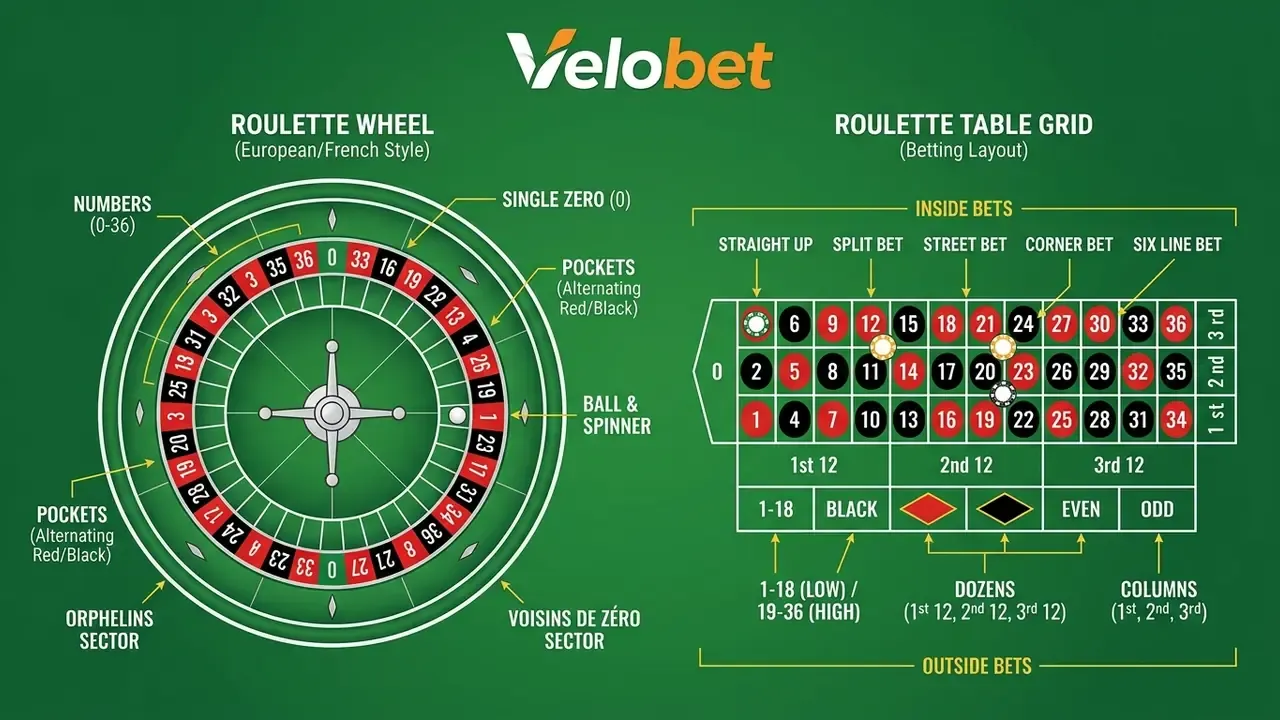
Understanding roulette rules begins with recognising the layout of the table and wheel. The roulette table features a felt betting grid displaying numbers 1 to 36 (alternating red and black) along with green zero sectors (single zero 0 in European layouts, plus double zero 00 in American layouts). Surrounding the number grid are outside betting boxes for broader categories such as Red/Black, Even/Odd, and Dozens. Whether you are playing digital RNG roulette or live dealer tables, every round strictly follows the dealer's cycle: opening wagers, announcing "no more bets," resolving the spin, clearing losing chips, and paying out winning bets according to established odds.

The physical geometry is worth memorising because it is the only variable that genuinely changes your odds. The numbers 1 to 36 sit in a 3x12 grid on the felt, zero (and double zero on American layouts) is placed separately at the dealer end, and the wheel sequence around the rim is deliberately not numerical. That mismatch between felt order and wheel order is exactly why sector-based "call bets" exist.

Roulette Rules How the Table Game
European Roulette Table Setup featuring the 3x12 number grid, single green Zero (0), and outside betting fields (Red/Black, Odd/Even, Dozens, Columns)

Alt text: Annotated diagram of a single-zero European roulette table and wheel layout showing inside and outside betting zones.

Roulette Wheel, Ball, and Dealer Role

The outcome of each roulette round depends on the physical or algorithmic movement of the ball within the revolving wheel. In physical and live dealer setups, official gaming regulations, such as those enforced by the Singapore Gambling Regulatory Authority, require the dealer to spin the ball in the direction opposite to the wheel's rotation, with at least four complete revolutions around the track for a spin to be valid.

"A 'Spin' means the dealer causing the ball to roll around the wheel, spun opposite to wheel rotation and completing at least four revolutions." Gambling Regulatory Authority of Singapore, Roulette (RWS) Game Rules, Version 3 (2026). https://www.gra.gov.sg/docs/default-source/game-rules/rws/roulette-games/

The dealer manages game pacing and ensures rule compliance. In live online roulette, the dealer announces the opening of the betting window, monitors countdown timers, and declares "No More Bets" (or Rien ne va plus) as the ball decelerates. Once the ball drops into a numbered pocket, optical character recognition (OCR) technology or manual dealer entry logs the winning number into the system, triggering immediate automated payout calculations for all online participants. If a physical spin fails to complete four revolutions, or the ball is launched improperly, the dealer declares a "No Spin," invalidating all bets for that round. The same principle applies in reverse: if the ball is released in the same direction as the wheel's rotation, published table rules also require the dealer to call "No Spin." The role of the dealer is therefore procedural and validity-checking, never result-selecting.

Worth saying plainly, because the myth is stubborn: a dealer cannot aim the ball at your number, and cannot aim it away from it either.

The dealer manages game pacing and

How to Select Chips and Place Bets

To place a bet in online roulette, select your desired chip denomination from the digital toolbar and click directly on the designated area of the betting felt before the timer expires. Each chip represents a specific monetary or virtual value, and its precise placement dictates the type of bet made.

Wagers are divided into specific placement boxes on the felt layout. Clicking directly inside a single number box places a Straight Up bet. Placing a chip on the dividing line between two numbers forms a Split bet, while placing it on the outer boundary line of a three-number row forms a Street bet. In online casino interfaces, players must confirm their chip placement before the "Bets Closed" signal appears. Any chip dropped outside marked betting boundaries, or submitted after time expires, will not be accepted for the active spin.

Digital interface controls and betting shortcuts

Modern RNG and live roulette software include specific control buttons designed to optimise stake placement within strict round timers:

How to Select Chips and Place
  • Re-Bet and Double (2x):immediately duplicates chip selections from the previous spin, or doubles all active stakes on the board with a single click. Some providers also expose a "re-double" control for stacked progression play.
  • Sliding bet and drag-and-drop:allows continuous chip dragging across adjacent splits, streets or columns on touchscreen mobile displays, so you can lay a multi-chip pattern in one gesture instead of tapping each cell.
  • Statistics and hot/cold numbers:displays real-time statistical distributions of the last 100 to 500 spins, highlighting "hot" (frequently hit) and "cold" (infrequently hit) pockets. Note: past outcomes do not influence future probability, so this panel is presentation, not prediction.
  • Betting history and favourite bets:lets you save custom multi-chip betting patterns (for example, specific racetrack combinations) and deploy them instantly with one click, which matters enormously on 25-second Speed Roulette tables.
  • Undo and Clear All:removes the last placed chip or wipes the layout before the betting window closes. On a phone screen this is the single most useful control for avoiding accidental misclicks.
Velobet heading-banner

Roulette Bets: Inside Bets, Outside Bets, and Payouts

Roulette bets are divided into inside bets, which cover specific individual numbers or small groups with higher payouts and lower probabilities, and outside bets, which cover large categories of numbers with lower payouts and higher mathematical odds of winning.

The mathematical structure of the game balances risk and reward: as the number of individual pockets covered by a single bet increases, the probability of winning rises, while the payout multiplier decreases proportionally. Betting on a single number yields a high 35:1 payout but carries a low probability of occurring (2.70% on a European wheel). Conversely, placing an outside bet on Red covers 18 pockets, offering a high probability of success (48.65%) but paying out at 1:1. Regardless of bet type, the baseline house edge on standard European roulette remains constant at 2.70% across all standard wagers.

Roulette Bets Inside Bets, Outside Bets

"Expected profit per unit staked equals -1/37 for every standard bet type on a single-zero wheel." Mathematical Modelling of Probability and Profit in Single-Zero Roulette (2023). https://link.springer.com

Table: characteristics of standard European roulette bets (37 pockets)

Bet NameClassificationTable PositionNumbers CoveredWin ProbabilityPayout RatioRelative Risk Level
Straight UpInsideDirectly on 1 number12.70%35:1Very high
SplitInsideLine between 2 numbers25.41%17:1High
StreetInsideOuter line of 3-number row38.11%11:1High
CornerInsideIntersection of 4 numbers410.81%8:1Medium-high
Six Line / LineInsideIntersection of 2 rows616.22%5:1Medium
Dozen / ColumnOutside12-number marked boxes1232.43%2:1Moderate
Red/Black, Odd/Even, High/LowOutsideOuter category boxes1848.65%1:1Lowest standard risk

Read the table as a trade-off curve, not a ranking. None of these bets is "better" in expectation on a European wheel; they simply distribute the same 2.70% cost across very different volatility profiles.

Inside Bets: Numbers and Number Groups

Inside bets are placed inside the main numerical grid (0 to 36) on the roulette table felt. These bets suit players seeking higher single-round payouts who are comfortable with greater outcome volatility.

The standard inside bet types and their mathematical specifications on a European single-zero wheel include:

  • Straight Up (1 number):pays 35:1. Win probability: 1/37 = 2.70%. On a 38-pocket American wheel the same bet wins only 2.63% of the time.
  • Split (2 numbers):chip placed on the line separating two adjacent numbers. Pays 17:1. Win probability: 2/37 = 5.41% (American: 5.26%).
  • Street (3 numbers):chip placed on the outer edge of a three-number horizontal row. Pays 11:1. Win probability: 3/37 = 8.11% (American: 7.89%).
  • Corner (4 numbers):chip placed at the central intersection point where four numbers meet. Pays 8:1. Win probability: 4/37 = 10.81% (American: 10.53%).
  • Six Line / Line (6 numbers):chip placed at the outer intersection of two adjacent three-number rows. Pays 5:1. Win probability: 6/37 = 16.22% (American: 15.79%).
Inside Bets Numbers and Number Groups

Outside Bets: Red, Black, and Other Outside Options

Outside bets are located along the perimeter of the main numerical grid. They cover broad mathematical subsets of numbers, providing lower volatility and significantly higher odds of winning on any individual spin.

The primary outside bets include:

  • Red or Black:wagers on the winning colour. Covers 18 pockets. Pays 1:1. European probability: 18/37 = 48.65%.
  • Even or Odd:wagers on whether the winning number will be even or odd, excluding 0. Covers 18 pockets. Pays 1:1. European probability: 48.65%.
  • High (19-36) or Low (1-18):wagers on number range. Covers 18 pockets. Pays 1:1. European probability: 48.65%.
  • Dozens (1st 12, 2nd 12, 3rd 12):wagers on specific 12-number blocks. Covers 12 pockets. Pays 2:1. European probability: 12/37 = 32.43%.
  • Columns (12 numbers):wagers on one of three vertical 12-number columns on the table. Covers 12 pockets. Pays 2:1. European probability: 32.43%.
Outside Bets Red, Black, and Other

A small but common misreading: Red is not a 50/50 proposition. Zero is neither red nor black, and that single green pocket is the whole business model.

Call Bets (Announced Bets) and the Racetrack Layout

In European and French roulette, players can place call bets (also called announced bets) covering specific arcs of the physical wheel. These wagers are laid out on an oval-shaped betting grid called the racetrack, which mirrors the exact sequence of numbers on the wheel rather than the numerical grid on the felt. Because the racetrack follows wheel order, a single click deploys a multi-chip combination that would otherwise take several seconds to build manually.

  • Voisins du Zéro (neighbours of zero):covers 17 numbers (from 22 to 25 in wheel order) using 9 chips placed as a combination of splits, corners, and a three-number trio (0, 2, 3).
  • Tiers du Cylindre (third of the wheel):covers the 12 numbers opposite zero (5/8 through 10/11) using 6 split bets, one chip per split: 5/8, 11/14, 13/16, 23/24, 27/30, 33/36.
  • Orphelins (orphans):covers the remaining 8 numbers not included in Voisins or Tiers (1, 20, 14, 31, 9 and 17, 34, 6) using 5 chips, one Straight Up on 1 plus 4 splits.
  • Zero Spiel (zero game):a smaller 4-chip subset of Voisins covering the 7 numbers closest to zero (12, 35, 3, 26, 0, 32, 15).
  • Neighbour bets ("x and neighbours"):selecting any single number on the racetrack automatically covers that number plus a symmetrical set of adjacent pockets, typically 2 on each side, for 5 straight-up chips in total. Most providers, including Amusnet's Live European Roulette, expose this as a dedicated "sector and neighbours" control.
Velobet heading-banner

Important caveat: call bets are convenience shortcuts, not value plays. Every chip in a Voisins or Tiers combination is still an ordinary split, trio or straight-up bet carrying the same -2.70% expectation, so the total expected loss is identical to placing those chips one by one on the felt.

What Affects Odds and House Edge

The house edge in roulette represents the mathematical margin built into the game paytable that guarantees a long-term casino advantage. This margin is generated by the presence of the green zero sector or sectors, which pay nothing on even-money outside bets (unless special French rules apply) while payout multiples are calculated as if the wheel contained fewer pockets than it actually does.

On a European single-zero wheel with 37 pockets, a winning Straight Up bet pays 35:1. However, the true odds against winning are 36 to 1. The expected value (EV) per unit wagered is:

EV = (35 x 1/37) - (1 x 36/37) = -1/37, or roughly -2.70%

When an additional double zero (00) sector is added, as in American roulette, the total pocket count increases to 38 but winning payouts remain unchanged. That shifts the arithmetic:

EV = (35 x 1/38) - (1 x 37/38) = -2/38, or roughly -5.26%

The addition of the second zero pocket nearly doubles the casino's mathematical edge over the player, from 2.70% to 5.26%. Same game, same chips, twice the cost.

What Affects Odds and House Edge

"Players attribute luck to 'lucky' dealers or fellow players at the table, although roulette outcomes are entirely random." Who Do I (Not) Ask to Play my Lottery? Effects of Perceived Agency and Luck on the Illusion of Control by Proxy, Journal of Gambling Studies (2024). https://link.springer.com/journal/10899

That illusion-of-control effect is the psychological counterpart to the formulas above. Because the maths cannot be influenced, players unconsciously look for a human proxy: a dealer on a "hot streak," a lucky seat, a favourite number, anything that restores a feeling of agency.

Variants of Roulette: European, American, and French

The three traditional variants of roulette, European, American and French, differ in wheel layout, zero pocket count, table rules, and expected player return (RTP).

Selecting the right variant is the single most effective choice a player can make to minimise the casino's mathematical edge. European roulette features a 37-pocket single-zero wheel, establishing a standard 2.70% house edge. American roulette adds a double-zero sector, creating 38 pockets and elevating the house edge to 5.26%. French roulette uses the European single-zero wheel layout but incorporates special table rules, La Partage or En Prison, that cut the house edge on even-money bets in half to 1.35%.

Table: roulette variant comparison at a glance

Variants of Roulette European, American, and
VariantPocketsZero SectorsHouse Edge (standard bets)RTPSpecial Rules
European3702.70%97.30%None
French3701.35% on even-money bets; 2.70% elsewhere98.65% / 97.30%La Partage, En Prison, racetrack call bets
American380 and 005.26% (7.89% on Top Line)94.74%Five-number "Basket" bet

European Roulette and Single Zero

European roulette is the standard baseline variant across online and live casinos worldwide. The wheel features 37 pockets numbered 0 through 36, with the single green zero (0) acting as the house pocket.

Because European roulette contains only one zero, all standard bets operate with a baseline house edge of 2.70%, corresponding to an RTP of 97.30%. For players comparing online catalogue options, European roulette tables offer clearly superior statistical value against double-zero alternatives. They are also the version most widely offered in demo mode, which makes them the natural place to learn chip placement before any money moves.

European Roulette and Single Zero. European

American Roulette and Double Zero

American roulette is characterised by its 38-pocket wheel, which includes both a single zero (0) and a double zero (00). This configuration is common in land-based American casinos and on many online platforms.

The presence of two zero pockets increases the house edge to 5.26% (RTP of 94.74%) on all standard bets. American roulette also features a unique wager called the "Top Line" or "Basket" bet, covering five numbers: 0, 00, 1, 2 and 3. It pays 6:1 but exposes the player to a steep 7.89% house edge, making it one of the mathematically weakest wagers in table gaming.

"Adding the double zero roughly doubles the player's expected loss, from 2.70% to 5.26% on most standard bets." Mathematical Modelling of Probability and Profit in Single-Zero Roulette (2023). https://link.springer.com

Practical takeaway: if a lobby shows a European and an American table at the same stake level, the American table costs you roughly twice as much per unit wagered for identical gameplay. There is no compensating feature, no bonus, no higher payout, that offsets the second green pocket.

French Roulette and Special Table Rules

French roulette is built on the 37-pocket single-zero wheel layout but includes specific French rules that protect even-money outside bets when the ball lands on zero.

The primary French roulette rules are:

  • La Partage ("the sharing"): if the ball lands in the green zero (0) pocket, players who placed even-money outside bets (Red/Black, Odd/Even, High/Low) automatically receive 50% of their stake back and lose only the remaining half.
  • En Prison ("in prison"): when zero hits, even-money wagers are locked on the table for the next spin. If the bet wins on the subsequent spin, the player recovers the original stake in full, without additional profit.

Mathematically, both La Partage and En Prison reduce the house edge on even-money bets from 2.70% to 1.35%, lifting the effective RTP to 98.65%. Note the boundary condition: the reduction applies only to even-money outside bets. A Straight Up or Split bet on a French table still carries the standard 2.70% edge.

French Roulette and Special Table Rules

"La Partage and En Prison reduce the house edge on even-money bets from 2.70% to 1.35%, confirmed by combinatorial analysis." Mathematical Modelling of Probability and Profit in Single-Zero Roulette (2023). https://link.springer.com

💡 Fact check: rules change the maths, betting systems do not Empirical probability research confirms that no betting pattern, progression system or stake-sizing sequence can alter the fixed mathematical house edge of a fair roulette wheel. According to the Springer 2023 mathematical modelling of single-zero roulette cited above, the edge is determined strictly by wheel geometry (37 versus 38 pockets) and paytable ratios, with expected profit per unit staked fixed at -1/37 regardless of bet type. Choosing a French single-zero table over an American double-zero table permanently reduces your expected loss per unit wagered from 5.26% to 1.35% on even-money bets, whereas applying progressive doubling systems such as Martingale leaves the expected loss rate completely unchanged. In short: the rules you sit down to are adjustable, the randomness of each spin is not.

Online Roulette: Demo Mode vs Real Money Play

Roulette online comes in two primary formats: free demo mode using virtual practice credits, and real money mode using deposited funds. Demo mode lets players test wheel mechanics, game rules and betting layouts without financial exposure, while real money play involves cash stakes, withdrawable payouts, table limits and identity verification requirements.

"Before you deposit a single rupee, test the game mechanics in demo mode and verify the platform's payout terms." Nisha Rao, Editorial Lead at Casino and Betting India (editorial brief)

For Indian users exploring online casino platforms, the choice between demo play and real money gaming depends on your current objective. Roulette demo tables operate with fictitious balances that carry zero monetary value. They provide a useful testing ground for understanding inside and outside bets, observing spin mechanics, and checking interface responsiveness on mobile screens. Real money roulette shifts the same game onto actual cash accounts, where payouts settle into withdrawable funds but every spin risks staked capital. Under evolving regulatory frameworks in India, including the Promotion and Regulation of Online Gaming Act 2025 and associated MeitY rules, players must also navigate payment verification, age checks (18+ or 21+ depending on jurisdiction), and local banking friction when moving to cash play.

For Indian users exploring online casino

"Simulated gambling is associated with an increased likelihood of migration to real-money wagering among young people." Systematic Review of Social Gaming (2023). https://www.ssrn.com

That finding is why we treat demo play as a learning tool with a defined endpoint, not as entertainment in its own right. Use it to memorise the layout and payout ratios, then decide deliberately, with a budget already fixed, whether to move to cash play at all. If you do progress, compare online casinos for Indian players on licensing and payout terms before completing account registration.

Table: roulette demo mode vs roulette real money play

FeatureRoulette Demo ModeRoulette Real Money Mode
Primary goalPractise rules, test layouts and evaluate software UI without financial risk.Wager real currency for the chance of withdrawable cash payouts.
Currency / fundsFictitious credits or virtual chips, non-redeemable.Real currency (INR or supported deposit methods) from a funded account.
Account requiredUsually no; most RNG demos launch instantly in-browser.Always yes; registration, age check and KYC apply.
Live dealer accessGenerally restricted or unavailable; mostly RNG-based tables.Full access to live dealer streams and RNG table formats.
Financial exposureZero risk of monetary loss.Full exposure to loss of staked capital on every spin.
Withdrawals and KYCNo withdrawal function; no identity verification required.Winnings withdrawable subject to KYC, bonus terms and payout limits.

The short version of that table: demo teaches the game, real money tests your discipline.

How Demo Roulette Works

Demo roulette mechanics use virtual chips and certified random number generators to simulate a physical roulette wheel without risking real funds. When you launch a demo roulette game, the software allocates a fictitious balance, often 1,000 to 10,000 virtual credits, allowing you to place bets across the numerical grid, watch the virtual ball trajectory, and check payout ratios.

The underlying maths engine in legitimate demo tables mirrors the real money version. Under technical gaming standards such as the UK Gambling Commission's RTS 7, RNG outcomes must be uniformly distributed, unpredictable, non-repeating and properly seeded.

How Demo Roulette Works. Demo roulette

"Auditing fairness by betting allows sequential statistical confirmation that RNG outcome distributions remain uniform." Auditing Fairness by Betting, NeurIPS (2023). https://arxiv.org

So a single-zero European wheel in demo mode keeps the same 2.70% theoretical house edge as its cash counterpart. Demo mode is a zero-risk tool for learning chip placement, understanding neighbour bets on the racetrack, and testing software performance on smartphone browsers before you register.

Practical notes on accessing demo tables:

  1. No account is usually needed for RNG demos. European, American, French and Mini Roulette demos typically launch straight from a game gallery in a mobile browser, with no download or sign-up. Some regulated markets, however, force a logged-in session even for free play.
  2. Live dealer roulette is almost never available in demo. Live tables run on physical equipment with real dealers and shared rounds, so studios cannot allocate virtual credits to a seat. You may be able to watch a live table as a spectator, but you cannot place free bets on it.
  3. Finding demos on a smartphone: open the casino's table-games category, filter by "Roulette," then look for a "Play for fun," "Demo" or "Practice" toggle on the game tile. If a tile only offers "Play," the game is real money only.
  4. Demo balances reset, not accumulate. Refreshing the page usually restores the starting virtual balance, which is also why demo results tell you nothing useful about your future real money variance.
So a single-zero European wheel in

What Changes in Real Money Roulette

Real money roulette replaces virtual credits with cash balances, introducing financial exposure, strict table minimums and maximums, and mandatory regulatory controls. Winning bets return real currency calculated by the standard payout table, while losing bets are permanently deducted from your casino balance.

When you move to real money play, platforms enforce table limits designed to manage risk for both sides. Nevada gaming regulations, for example, require table minimums and maximums to be clearly posted on the game interface, with aggregate payout limits applied to high-odds bets. Nevada's table-game rules permit an aggregate payout limit on odds above 50:1, set at no less than the highest award at the posted minimum bet or US$25,000, whichever is greater (Nevada Gaming Control Board table-game rules; verify the current filing for your specific table). Real money play also activates compliance protocols: regulatory standards in jurisdictions such as Ontario and the UK mandate player-set deposit limits, loss caps, and identity verification before processing withdrawals or deposits above regulatory thresholds (for instance €2,000 under UK AML guidelines). In Ontario, operators must offer deposit and loss limits at registration and afterwards, covering 24-hour, 7-day and one-month periods, with limit reductions taking effect only after a 24-hour cooling-off period.

What Changes in Real Money Roulette

"Interactive table games generated hundreds of millions of dollars in gross gaming revenue under full operator regulatory oversight." Pennsylvania Interactive Gaming Report (2024). https://www.pa.gov

⚠️ Responsible gaming and jurisdictional notice Real money roulette involves real financial risk and should be treated purely as paid entertainment, never as a source of income or a way to recover losses. It is restricted to legal adults (18+ or 21+ depending on local jurisdiction and platform rules; the UK, EU and South Africa apply 18+, while the Philippines and several US standards apply 21+). In India, online real money gaming is subject to state-level regulation and federal guidelines under the Promotion and Regulation of Online Gaming Act 2025. Always set strict budget limits and verify local legal requirements before depositing. This information is general and does not replace advice from a qualified legal or financial professional. Check the legislation applicable in your state or region before making a deposit.

Live Roulette: Playing with Live Dealers in Online Casinos

Live dealer roulette connects online players to a real studio environment via high-definition video streams, where human dealers operate physical roulette wheels in real time using optical character recognition and interactive betting overlays.

Unlike digital RNG roulette, where outcomes are calculated by software, live roulette outcomes are generated by physical equipment. Studio cameras capture every rotation of the wheel and ball, converting the landing pocket into digital data through OCR software. Players place bets using a graphical overlay on their screen, which blends the convenience of playing roulette online with the visible transparency of a live table. Technical standards such as GLI-19 describe this delivery layer as real-time remote audio and video streaming plus a graphical betting interface, while the UK Gambling Commission notes that live dealers determine results using physical equipment. In other words, the outcome layer and the streaming layer are regulated separately.

Live Roulette Playing with Live Dealers

How a Live Dealer Round Works

A round of live dealer roulette runs on a synchronised real-time schedule managed by the studio software and game host.

  1. Betting window opens: the digital timer counts down, typically 15 to 20 seconds, while players select chips and click on the grid overlay.
  2. Spin initiation: the dealer spins the physical wheel and launches the ball in the opposite direction.
  3. Betting window closes: at 5 seconds remaining, the interface displays "LAST BETS," followed by "BETS CLOSED." No further wagers are accepted.
  4. Pocket capture (OCR): the ball settles into a pocket. Overhead camera sensors and OCR scanners read the physical result and transmit the numeric output to the central game engine.
  5. Automated settlement: the system instantly credits winning accounts based on table odds and clears losing wagers, resetting the layout for the next round.
How a Live Dealer Round Works

How to Choose a Live Roulette Table

When selecting a live roulette table, evaluate four core technical and operational parameters:

  1. Table limits: check the minimum and maximum bet thresholds posted in the lobby. Limits should align with your session bankroll, for example ₹50 minimums for casual players versus far higher VIP thresholds. Regulated rule sets require permissible minimum and maximum limits to be displayed at the table, and many providers publish separate per-bet-type limits for Straight Up, Split, Street, Corner, Line, Column, Dozen, Red/Black, Even/Odd and Low/High.
  2. Rule variant: prioritise Live French Roulette with La Partage over standard European or American live tables to secure the lower 1.35% edge on even-money bets.
  3. Language and studio interface: confirm the dealer speaks your preferred language and that the software provides clear audio-video controls and low-latency streaming. Many studios run dedicated Hindi-language tables during Indian evening peak hours.
  4. Mobile usability: verify that the betting overlay scales smoothly on smartphone screens without misclicks or lag on Indian mobile connections, particularly on 4G, where a stream stall during "last bets" can cost you a round.
How to Choose a Live Roulette

Roulette Strategy: Managing Bets Without False Profit Claims

📌 Disclaimer: information on bet-management strategies is general and educational, and guarantees no financial outcome. Roulette carries a negative mathematical expectation for the player under all standard rule sets.

Roulette strategies are structured frameworks for managing bet sizing and bankroll distribution. They do not, and cannot, change the negative expected value of the game.

Popular progression strategies such as Martingale, D'Alembert, Fibonacci and Paroli alter the distribution of short-term wins and losses, but they cannot overcome the built-in house edge. A 2024 academic study published on SSRN (The Art of Financial Illusion: How to Use Martingale Betting Systems to Fool People) used algorithmic simulations to show that progressive doubling generates frequent small wins in the short term while creating fat-tailed loss distributions, where long losing streaks inevitably wipe out accumulated profits.

Roulette strategies are structured frameworks for

"Martingale betting systems create the illusion of steady income while concealing rare but catastrophic, fat-tailed losses." The Art of Financial Illusion: How to Use Martingale Betting Systems to Fool People, SSRN (2024). https://ssrn.com

Responsible strategy therefore focuses entirely on bankroll discipline, strict loss limits, and accepting that every spin is an independent random event. Classical gambler's-ruin analysis reaches the same conclusion from another direction: with a negative expectation and a finite bankroll, sustained play trends toward ruin, and the probability of ruin rises the larger the profit target you chase.

Martingale, D'Alembert, Fibonacci, Paroli, Labouchère and Andrucci

Negative and positive progression systems adjust bet sizes based on prior outcomes, each with distinct mechanics and financial risks:

  • Martingale system (negative progression): double your wager after every loss on an even-money bet (1 unit, 2, 4, 8, 16 and so on). A single win recovers all previous losses plus 1 unit of profit. Risk: exponential stake growth means a streak of 8 consecutive losses requires a 256-unit wager, and a 10-loss streak requires 1,024 units. Table maximums or bankroll exhaustion will eventually break the sequence, producing a catastrophic loss.
  • D'Alembert system (negative progression): increase your bet by 1 unit after a loss, decrease it by 1 unit after a win. Risk: slower escalation than Martingale, but extended losing streaks still create cumulative drawdown that is hard to recover without long winning runs.
  • Fibonacci system (negative progression): raise bets along the sequence (1, 1, 2, 3, 5, 8, 13, 21) after a loss, and move back two steps after a win. Risk: consecutive losses inflate stakes quickly, exposing the bankroll to steep drawdown during cold runs. Growth is slower than Martingale but still becomes unplayable under a long enough streak or a low table maximum.
  • Paroli system (positive progression): double your wager after every win, resetting to the baseline 1-unit bet after three consecutive wins or any single loss. Risk: relies entirely on winning streaks. One loss wipes out accumulated streak gains and resets progress to the base stake.
  • Labouchère system (cancellation or split Martingale): create a sequence of numbers, for example 1-2-3-4. Each wager equals the sum of the first and last numbers (1 + 4 = 5 units). On a win, erase both numbers; on a loss, append the lost amount to the end of the sequence (1-2-3-4-5). Risk: a prolonged losing series inflates the sequence and creates steep capital demands similar to traditional Martingale, with the added drawback that bookkeeping errors are easy to make under a 20-second betting timer.
  • Andrucci system (chaos and hot-number tracking): based on short-term variance. The player tracks 30 to 37 consecutive spins to identify the most frequent "hot" numbers, then places Straight Up wagers on them for the next 30 spins. Risk: this is the fallacy of the law of small numbers. On a certified RNG or a balanced physical wheel, past distributions have zero statistical correlation with upcoming spins, and 37 observations are far too few to detect a genuine bias even if one existed.
Martingale, D'Alembert, Fibonacci, Paroli, Labouchère and

"For risk-averse gamblers, progressive systems with exponential stake growth are worse than flat betting in expected-utility terms." A Guide to the Risk-Averse Gambler and Resolving the St. Petersburg Paradox Once and For All, arXiv (2023). https://arxiv.org

Bankroll and Betting Limits

Effective bankroll management sets pre-determined operational limits that control session duration and prevent impulsive loss-chasing.

Key guidelines:

  • Single bet sizing:limit individual wagers to 1% to 2% of your total session bankroll. A ₹10,000 session balance implies baseline bets of ₹100 to ₹200.
  • Pre-set stop-loss:establish a rigid session stop-loss (for example 20% to 50% of session funds, or a 100% hard cap on the deposited session stake). Once reached, stop playing. Published bankroll guides vary between 10-20% of session bankroll and a full 100% session cap because they define "bankroll" differently, so pick one definition and write it down before you start.
  • Profit lock (stop-win):define a clear win target, for instance 20% to 30% profit, then lock in gains and withdraw once it is reached.
  • Use the operator's own tools:set deposit, loss and session-time limits inside your account before the first spin. UK rules require financial limits including loss limits to be offered, and Ontario mandates 24-hour, 7-day and one-month options with a 24-hour cooling-off period on reductions.
  • Avoid chasing losses:behavioural tracking data published in Scientific Reports (2024) shows that players frequently escalate bet sizing and extend sessions immediately after losses. Recognising that bias matters, because raising stakes after a loss in a negative-expectation game only accelerates bankroll depletion.
Bankroll and Betting Limits. Effective bankroll

"Players raised stakes and extended sessions after immediate losses, but reduced them following accumulated losses, based on real online casino data." Within-session chasing of losses and wins in an online eCasino, Scientific Reports (2024). https://www.nature.com/scientificreports

"After winning sessions, roulette players returned to the platform faster than after losing sessions, indicating between-session chasing of wins." Between-session chasing of losses and wins in an online eCasino, Journal of Behavioral Addictions (2024). https://akjournals.com/view/journals/2006

"Participants given alcohol or placebo alcohol placed significantly more bets than the control group." Contrasting the Effects of Alcohol and Alcohol Expectancies on Gambling Behavior, Journal of Gambling Studies (2023). https://link.springer.com/journal/10899

The practical synthesis of those three studies: the most dangerous moments in a roulette session are the minute after a sharp loss, the hours after a big win, and any session played while drinking. Pre-commitment tools, hard deposit limits, cool-off periods and closing the app after a stop-win, exist precisely because in-the-moment judgement is unreliable.

How to Choose a Roulette Casino and Access the Game

Selecting a reliable roulette casino requires evaluating valid regulatory licensing, software certifications, payment compatibility (INR and UPI support for Indian users), fair bonus contribution terms, and clear responsible gaming infrastructure.

When comparing online casinos, player safety and platform transparency should outrank marketing promotions every time. Regulated operators display active licences from established jurisdictions, publish verified eCOGRA or iTech Labs RNG audit reports, enforce robust SSL encryption, and provide accessible responsible gaming controls such as deposit limits, cool-off periods and self-exclusion registers.

How to Choose a Roulette Casino

"Licensed operators must submit games for fairness testing and provide responsible gaming tools under regulatory standards." Pennsylvania Interactive Gaming Report (2024). https://www.pa.gov

Formalised assessment frameworks exist and are worth borrowing. The NCPG Internet Responsible Gambling Standards cover policy, staff training, self-exclusion, advertising and site features, while the Responsible Gambling Council's RG Check iGaming accreditation applies 9 standards and 48 criteria to online gambling sites. Our own approach to choosing a licensed online casino mirrors those categories: licence verification, game and RNG certification, banking speed and fees, bonus fairness, and support responsiveness.

🚫 Red flags: when to avoid an online roulette platform Decline to deposit real funds if a platform shows any of the following:

  1. Unverifiable licensing: footer badges for MGA, Curaçao eGaming or similar without active, clickable verification links to the official regulator database, or misleading licensing claims it cannot evidence.
  2. Unusually long withdrawal delays: terms permitting processing beyond 5 business days for e-wallets and UPI, or documented user complaints citing delays of a year or more before payment.
  3. Locked-out accounts and unexplained closures: reports of accounts frozen or closed without a stated reason, particularly after a verified win.
  4. Predatory bonus contribution clauses: table-game contribution below 5%, hidden maximum-withdrawal caps applied to non-bonus cash balances, or aggressive time limits to clear wagering.
  5. Absent RNG certification: inability to produce recent public audit certificates from eCOGRA, iTech Labs, GLI or BMM Testlabs for RNG table games.
  6. Unresponsive or unprofessional support: no live chat, generic copy-paste replies to bonus and payout queries, or no response within 24 hours.
  7. Operator history: ownership groups previously linked to non-payment of winnings or to blacklisted brands.

Selecting Roulette Games and Formats

A high-quality roulette catalogue should provide diverse, verified game software from tier-1 licensed providers such as Evolution, Pragmatic Play, Playtech or Play'n GO.

Check whether the lobby offers European, French and live dealer table variants alongside free demo modes. Make sure game load speeds are optimised for mobile browsers, and verify that live streams keep stable latency on regional mobile connections in India. Three quick catalogue tests before depositing:

  1. RNG certification block: does each RNG table's info panel state the RTP (97.30% for European) and the testing lab?
  2. Variant depth: are French tables with La Partage actually present, or is the "French Roulette" tile simply a re-skinned European table without the rule?
  3. Mobile parity: do the racetrack, statistics panel and favourite-bet controls all work on a phone, or does the mobile client strip them out?
Selecting Roulette Games and Formats. A

Bonuses, Limits, and Terms Before Betting

Casino welcome bonuses frequently carry restrictive terms when applied to table games like roulette.

Before claiming a bonus to play roulette, verify three conditions in the terms and conditions:

  1. Game contribution rate: table games often contribute far less toward wagering requirements than slots. Slots typically contribute 100%, while roulette contribution rates commonly drop to 5%, 10% or 25% (documented operator terms range from 5% at some brands to 10% on all live roulette at others, and 25% elsewhere). A ₹1,000 bet on a roulette table with a 10% contribution counts as only ₹100 toward clearing wagering.
  2. Maximum bet caps: bonus terms almost always impose a maximum bet per spin, for example €5 or roughly ₹400. Exceeding it while playing with active bonus funds can void the bonus and forfeit winnings. Time limits are equally common, and some terms require full wagering to be cleared within 14 days.
  3. Withdrawal rules and KYC: confirm the platform supports workable withdrawal channels in India, such as UPI, NetBanking or local bank transfers, and states identity verification requirements clearly before your first cashout request.

Worked example: what a ₹1,000 bonus actually costs in roulette turnover

  • Bonus received: ₹1,000
  • Wagering requirement: 30x the bonus, so ₹1,000 x 30 = ₹30,000 of qualifying turnover
  • Roulette contribution rate: 10%
  • Required roulette turnover: ₹30,000 ÷ 0.10 = ₹3,00,000
  • Expected cost at the European house edge: ₹3,00,000 x 2.70% is roughly ₹8,100 in theoretical losses to unlock a ₹1,000 bonus.
  • Same calculation at 5% contribution: ₹6,00,000 of turnover and roughly ₹16,200 in expected losses.
  • With a ₹400 max-bet cap, ₹3,00,000 of turnover needs at least 750 spins. At Speed Roulette's 25-second rounds, that is over five hours of continuous play.

The conclusion is straightforward: roulette is usually the wrong game for clearing a slots-oriented welcome bonus. If you plan to play roulette anyway, weigh the value of declining the bonus (full flexibility, no max-bet cap, no expiry clock) against the nominal bonus amount. Quite often, declining wins.

Bonuses, Limits, and Terms Before Betting

FAQ: Online Roulette Questions from Indian Players

Is playing online roulette legal in India?

Roulette is classified as a game of pure chance, so it does not fall under the "game of skill" exemption applied to some formats. Legality depends on your state: Goa, Daman and Sikkim host licensed casino activity, while states such as Tamil Nadu, Telangana, Andhra Pradesh, Assam, Odisha and Nagaland have enacted restrictions on online money gaming. The Promotion and Regulation of Online Gaming Act 2025 and MeitY rules add a federal layer. Confirm your state's current statute, and consult a lawyer, before depositing.

Which roulette version has the best odds?

French roulette with La Partage or En Prison: a 1.35% house edge (98.65% RTP) on even-money bets. European is next at 2.70%. Avoid American roulette at 5.26%, and never take the Top Line five-number bet at 7.89%.

Can I win real money in demo mode?

No. Demo balances are virtual credits with no cash value and no withdrawal function. Demo mode exists to teach layout, payouts and interface handling.

Is live dealer roulette available for free?

Almost never. Live tables use physical equipment and shared rounds, so studios cannot issue free credits for a seat. Free play is generally limited to RNG tables.

Do I need an account to try a roulette demo?

Usually not. Most RNG roulette demos launch instantly in a mobile browser. Some regulated markets require a logged-in session even for free play.

What documents do international casinos ask Indian players for?

PAN card or passport for identity, a recent utility bill or bank statement for address, proof of the UPI or bank instrument used, and often a selfie liveness check. Names must match across the casino account, bank account and UPI handle.

How long do UPI withdrawals take?

Typically a few hours to 5 business days once KYC is complete, depending on method and internal review. Processing consistently beyond 5 business days is a red flag.

Does the Martingale system work?

No. It redistributes outcomes into many small wins and rare catastrophic losses, leaving expected value unchanged. Simulations published on SSRN in 2024 describe exactly this fat-tailed loss profile.

What is the difference between RNG roulette and live roulette?

RNG roulette resolves outcomes through a certified random number generator inside the game software. Live roulette resolves outcomes on a physical wheel in a studio, captured by cameras and OCR, then settled automatically. Both can share the same 97.30% European RTP.

Are "hot" and "cold" numbers useful?

No. They are a presentation feature. On a certified RNG or a balanced wheel, each spin is independent, so historical frequency carries no predictive value. That is precisely where the Andrucci system fails.

Before You Play: A Short Responsible Gambling Close

Roulette is entertainment with a fixed price attached. On a European wheel, that price is about ₹27 for every ₹1,000 wagered over the long run, and no strategy discounts it.

So the safe sequence looks like this. Learn the layout in demo mode. Check your state's legal position and read the withdrawal terms before you register. Decide your budget, your stop-loss and your stop-win in advance, then set those limits inside the account, not just in your head. If a session stops feeling like entertainment, use the cool-off or self-exclusion tools; every licensed operator must provide them, and organisations offering confidential support are worth contacting early rather than late.

Two closing habits that cost nothing: prefer single-zero and French tables when both are available, and treat any bonus as a set of restrictions first and a gift second. That is not a promise of profit, because there isn't one to make. It is simply how informed players keep control of the part of the game they actually own, their own limits.

Before You Play A Short Responsible